
Imaginal image
Rumour has it....


As always, Robert’s insights gave me food for thought.
Summary (ChatGPT)
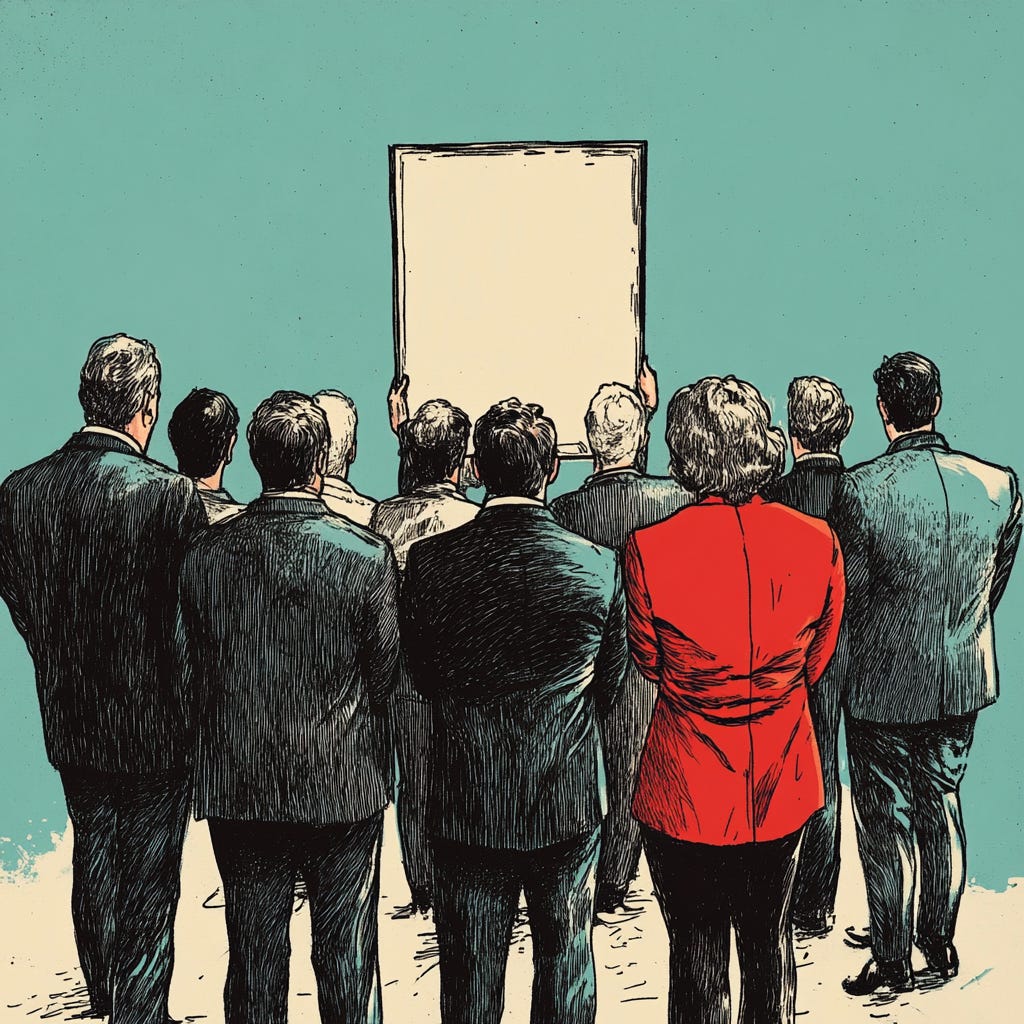
This post explores the psychology behind voting behavior and self-image, drawing on insights from William James and the "Eliza-effect." It notes that most eligible Americans either abstain from voting or are ineligible, forming a "party" of non-voters, and suggests that psychological factors explain both the act of voting and non-voting, as well as the recent shift towards right-leaning votes.
Self-image is framed as a balance between "success" and "pretensions," with social media and screen interactions exacerbating this need for validation. Influencers embody this cycle, needing followers to boost their success while followers experience lowered self-esteem, creating a loop of dependency and diminished self-worth. The post also discusses how the concept of AI has skewed perceptions of human intelligence, with AI seen as superior despite "intelligence" itself being an abstract construct.
To foster trust and engagement in group settings, the author suggests sharing personal details, forming small discussion groups, and embracing feedback. This, combined with avoiding excessive interference, encourages introspection, learning, and collective growth, despite the inherent paradoxes and regression often present in group dynamics.
It's the psychology, stupid.
One may have noticed a drop in intelligent behaviour and conversations - present audience excluded.
Facts
"Around 87 million eligible voters did not participate in the election; Donald Trump received approximately 74.65 million votes; Vice President Kamala Harris, garnered about 70.9 million votes, of an estimated population of approximately 346 million. " (according to ChatGPT).
So the largest party in the US are non-voters and people not eligible to vote. Trump and Kamala were beaten by non voters. Why people vote AND not vote - and why people now tend to vote "right", can by explained by psychology.
mirror, mirror thyself
William James - founding father of psychology - noticed that self image = success / pretensions.
The more success, the more pretentious you become. And - to keep a positive self-image - the more success you need. If you're beaten at the Olympic games, you're still one of the very few able to participate. Yet you still feel "bad". (Also, remember in "The Wizard of Oz", (Us?) the man behind the curtain, pretending to be great and mighty).
Eliza is here
Not many people realize that using computers - and therefore social media - actually have an effect on self-image. It's called the Eliza-effect https://en.wikipedia.org/wiki/ELIZA_effect It was first described in the 1960's by prof. Weizenbaum. (I used this in my thesis for my MBA in information system design to show information is a hoax. I got away with it, but I would advice against it, :-).)
People attribute more intelligence to something on a screen than to an actual person. (See also "computer says 'no'" , https://en.wikipedia.org/wiki/Computer_says_no)
There’s no AI in brain
Before using "screens", people used to think they were intelligent animals (ia :-). Currently, they seem to think they're going to be beaten by AI, artificial intelligence. AI - the fact that AI is superior is symbolized by the use of capitals. Intelligence is a completely artificial concept.
Intelligence is an explanatory concept, a convenience to stop thinking - sic.
“…an explanatory principle – like ‘gravity’ or ‘instinct’ – really explains nothing. It’s a sort of conventional agreement between scientists to stop trying to explain things at a certain point.” Gregory Bateson (1972). Metalogue: What is an instinct? Steps to an Ecology of Mind. New York: Chandler, 38-58
(As a physicist, I can state that 'gravity' doesn't explain why apples fall to the ground, while they being not told about of the existence of gravity, nor being enforced by gravity police. It's what Newton invented to explain it).
Mirror me
This use of "mirrors", screens, "smart phones" (there's nothing smart about a phone, it's phoney) simply explains "success" of "influencers" (and their psychological problems). Paradoxically, their need of attention - success - requires influencers to have followers, who get a lower self-image AND then need the success of "influencers" to feel better about themselves.
I also read, - it might be gossip - that most IT tycoons don't let their children use screens.
True rumours
Paradoxes of Engaging, see Smith and Berg, Paradoxes of Group Life: "Disclosure, Trust, Intimacy and Regression". Making up stories - "gossip" - actually builds trust (long story, because a paradox), induces "in group" feelings and regression. This regression again, one needs to sustain belonging and gossiping. It becomes simpler, when you can see paradoxes at work. It induces an addiction cycle.
So, in my view, it is both complicated and simple: most voters maintain a positive self-image by telling themselves it's better for them not to vote. Voters with a lower self-image and/or in need to preserve themselves and/or an addiction to success (which differs from actually being successful, “is an addict successful?”) will vote for the best story (aka promises). And voters wanting to cast the right vote, vote left. And see their defeat as proof of their world-view.
Implications for facilitating groups of people
Always disclose something about yourself at the beginning of a meeting. For instance, how you’re feeling right now. Also used to be in the here-and-now.
You start to share something, like a Post-It, a piece of paper, a picture card, before you invite participants to share.
Let people share something in small - intimate - groups, preferably in fives, for instance in getting to know each other. Prevent introductions of each other in larger groups.
trust yourself. Success usually deprives people of learning. Negative feedback enables reflection, contemplation, search for alternatives. It provides contrast.
Check your assumptions, for instance when you try to convince others, or a debate emerges.
People in groups are massively (also literally) regressed. And it’s a necessary - though not sufficient - condition for progress. “Reculer pour mieux sauter”, as the French would say; back up to jump better.
When people are engaged, they will lock you out. Don’t interfere.
If you want to make a "new" model based on methaphor George Lakoff and the "Embodiment" "Movement" shows a interesting explanation based on the proces of "growing" into a body that is able to walk.
In general I believe that new models are nothing but old models with different names.
Will McWhinney rephrased an old theory of Gustav Jung and Jung rephrased Alchemy and Alchemy was already known before Egypt was created.
By the way there are Five Elements: https://constable.blog/2024/11/07/de-geschiedenis-is-een-fractaal-proces/
The relationship between Rules (Unity) and a Group (social) is referred to as Politics in Paths of Change by Will McWhinney. This relationship functions in two ways. Within the group, the individual is unaware that the politician is attempting to enforce a Law or Pattern, unless it is transformed into a Religion, a Method, or a Vision. In such cases, the individual can express an Opinion. A politician who successfully enforces their goals without any feedback from their target group is an expert in manipulation or a facilitator.